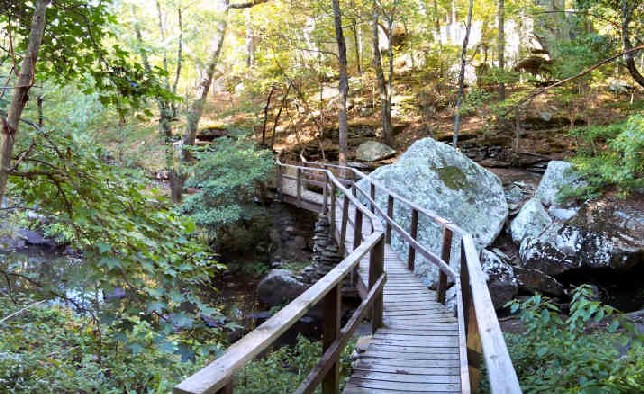
Besides hiking and camping, other activities in the park include
fishing, picnicking, swimming, tennis or volleyball. Pedal boats,
water bikes and flat bottom boats are available for rental on Lake
Bailey.
The lodge restaurant provides a good selection of reasonably
priced food for breakfast, lunch and dinner, and a very friendly
wait staff.
80 acres (0.3 km²) - original size of park in 1923
3,471 acres (14.05 km²) - size of park today
1,207 feet - elevation above sea level
65 miles - park's approximate distance northwest of the state
capitol, Little Rock
24 rooms in rustic Mather Lodge
20 cabins with kitchens
12 cabins without kitchens
126 camping sites
37 RV pull-through sites
170 acre (69 ha) - size of Lake Bailey
95 feet (21 m) - Cedar Creek's drop over Cedar Falls
20 plus - number of miles of trails
7 - number of trails:
-
Cedar Falls - 2 miles, 2 hours
-
Boy Scout - 12 miles, 8 hours
-
Cedar Creek - 1.25 miles, 1.5 hours
-
Seven Hollows - 4.5 miles, 4 hours
-
Canyon Trail - 1 mile, 2 hours
-
Rock House Cave - .25 mile, .5 hour
-
Bear Cave Trail - .25 mile, .5 hour
80 plus - things built in the park during the Great Depression
by the Civilian Conservation Corps, including buildings,
bridges, roads and hiking trails
30 plus - number of automobiles donated by private collectors to
the Museum of Automobiles near the park
before c. 1000 A.D. - Rock House Cave home to Native Americans
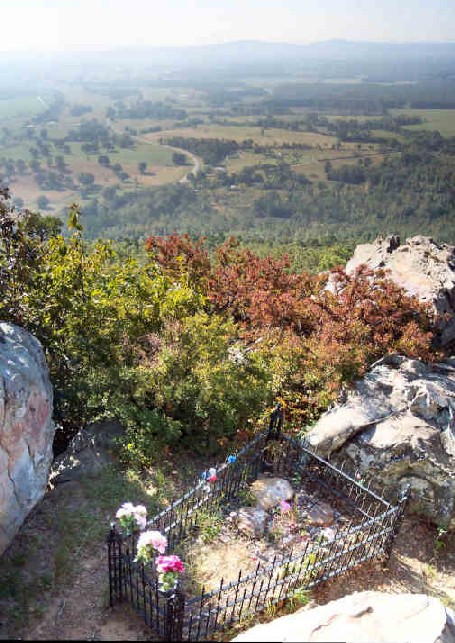
 1700s
- according to legend, a French girl, who had been disguised as
a cabin boy known to the crew as "Petit Jean" (Little Jean or
John), was buried atop the mountain at what is now Stout's
Point.
1700s
- according to legend, a French girl, who had been disguised as
a cabin boy known to the crew as "Petit Jean" (Little Jean or
John), was buried atop the mountain at what is now Stout's
Point.
1840s - John Walker family makes their home on the mountain
1854 - Walker Family moves to Carden Bottoms at the foot of the
mountain on the west
1856 - Owen West moves into the Walker cabin
1891 - Nelson family builds a large two story home near the
Petit Jean "grave" site; planted apple orchard; successful in
apple business for several years
abt. 1897 - William Cummings Stout and his
wife buy the Nelson land; open Hotel Petit Jean in what
had been the Nelson's home; supposedly had a copy of the
"original" legend of Petit Jean written in French that was kept
in the back of an old bible. Land in area of "grave" becomes
known as Stout's Point
1907 - inception of the idea of a national park on the mountain
1920s - Mr. Stout sold the hotel property. Later property was
donated to YMCA, who operated it as a children's summer camp,
constructing several more buildings including College Lodge,
used as an administration and meeting facility.
1921 - Ft. Smith Lumber Company offers to deed their land to the
federal government for use as a national park; Petit Jean
National Park bill introduced in Congress
1933 to 1938 - Civilian Conservation Core Company 1781, a
company of mostly World War 1 veterans with construction work
experience, builds structures, roads, and trails on the mountain
that are still in use today. Walker cabin is moved to
present location at head of Cedar Creek trail.
1940s - College Lodge is destroyed by fire.
1955 - Marguerite Turner wrote "Petit Jean," embellishing the
legend, giving the French Captain the name "Chavet" and
Petit Jean the name "Adrienne Dumont."
1964 - Winthrop Rockefeller establishes the Museum of
Automobiles on Petit Jean Mountain near the park. After his
death, his private collection of automobiles is sold and the
building an grounds are donated to the state of Arkansas
1976 - The Museum of Automobiles is reopened by a non-profit
organization with the collection restocked
1985 - renovation and upgrade of camping area A (50 amp
electrical, water and sewer hookup)