Attacks upon Public Parks.
The Century Magazine, (a popular
quarterly); Volume 43, Issue 3; The Century Company; Jan
1892; New York
THE fight to prevent the injury
and impairment of public parks, large and small, appears to be a
perpetual one. There is always springing up some new person or
persons possessed with a craving, as absorbing as it is
mysterious, to get into a park of some kind and do harm to it in
one way or another. If the park be a small one in a great city,
the hostile attack takes the form of a request to run a railway
across or over a corner of it, or to be granted a section for a
railway station or some other semi-public use. Plausible reasons
are always advanced in support of such propositions, the chief
of which usually is that the public convenience will be greatly
enhanced by the incursion. A few years ago it was proposed with
much seriousness to run an elevated railway across the Central
Park, and it was claimed that the structure might be of such
architectural beauty as to constitute an additional charm for
the park. Again it was proposed to construct along the entire
length of one side of the same park a speeding-track for horses
which should be devoted to fast driving by the owners of blooded
horses. In Boston and other cities the proposition is made anew
every year to allow the city parks to be used as training- and
parade-grounds for the militia.
The attacks upon the great
parks, those of the Adirondacks, the Yosemite, the Yellowstone,
differ only in degree. Somebody wishes to run a railway into or
through them, or to construct a highway across them, or to use
portions of them for some kind of private enterprise of a
profitable nature. The mere sight of so much property lying idle
appears to be irritating to the utilitarian spirit of the age.
Men wish to get at it and make it earn something for them. And
the first excuse that they make is that their particular project
will be a great public convenience. If it be a railway that they
propose, they say it will not injure the park, but bring its
beauties and delights within easy reach of thousands of people
who otherwise would never be able to enjoy them. If they wish to
cut down trees, they say they only desire to do so in order to
improve the views, to "open vistas" from hotels and thus
increase the enjoyment of visitors. "Opening vistas" has long
been the favorite device of park desolators all the way from New
York city to the Yosemite Valley, and is one of the most extreme
and violent forms of park vandalism ever invented.
All these attacks are open to
the same objection, which is unanswerable, that they remove, in
part if not entirely, the very qualities which are essential in
a park. The prime essential of a park in a great city is that
the noise and turmoil of the streets cease at its gates, and
that within is quiet, an opportunity to enjoy nature in its
cultivated aspect, and a certain freedom of action within limits
which are prescribed only for the greatest good of the greatest
number. Every respectably behaving person has as much freedom
there as if he were in his own grounds. All is as free to him as
it is to every one else. A railway across or over such a park,
or a use of any part of it for a semi-public purpose, destroys
both its quiet and its democratic equality, and its main charm
has been taken away.
In the case of a great park
like the Adirondack, or the Yellowstone, or the Yosemite, the
essential quality is that of a solitude, a wilderness, a place
of undisturbed communion with nature in all her primitive
beauty, simplicity, and grandeur. For such a solitude, vast
domain and practically complete separation from the developments
of civilization are indispensable. Run a railway into such a
place, and it ceases at once to be a wilderness. Nature flees,
never to be brought back again. With her go the wild game which
attracted the huntsmen and made camp life, with all its
restfulness and strength-giving qualities, possible.
A few years ago the Adirondacks
were a wilderness throughout almost their entire extent. To gain
access to some of their most charming solitudes, it was
necessary to ride forty or fifty miles by stages, an entire day
being necessary to “get into the woods" after the railway
journey had ended. In those days fish and deer and other game
were plenty, and a camper could pass weeks and months without
encountering more than a few casual signs of civilization. Then
came the railways; two of them were allowed to penetrate the
wilderness so far that a journey by rail could be made to points
within an hour or two of the parts hitherto most inaccessible.
What had been a wilderness became instantly a "summer resort."
Cheap hotels and boarding-houses sprang up everywhere, and the
woods were literally filled with visitors from all quarters. The
whistle of the locomotives drove the deer into the deepest
recesses of the forests, and the hordes of visitors, who had
neither a genuine love of sport nor a respect for game laws,
soon cleared the streams of fish. Now it is proposed to run a
railway across and through the Adirondack region, opening up a
large portion of it to settlement. This attack has been defeated
temporarily, but it has not been abandoned. If it shall succeed
ultimately, the Adirondack wilderness will soon be a thing of
the past.
For a long time the Yellowstone
Park was threatened with a similar destruction, but the
commendable action of the President, under authority of the last
Congress, seems to have removed it for all time. Repeated
attempts were made so to increase the size of the park as to
have it include the watershed of all the streams which flow into
the Yellowstone Lake, but legislation with this end in view was
for a long time prevented by a railway lobby, in the interest of
a road across one portion of the park, an invasion which would
be made impossible by the proposed addition. On the last day of
the session, however, Congress .passed an act authorizing the
President to declare that the additional territory desired had
been "withdrawn from entry" and should remain the property of
the nation. He has so declared, and the danger of destruction by
means of railways is safely and permanently passed. Congress
ought next to provide the park with a superintendent, at a
salary which would make it possible to obtain the best expert
talent for the purpose.
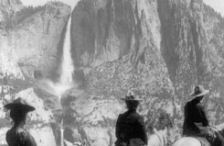
The condition of affairs in the
Yosemite Valley during the past year has been such as to confirm
the fears of lovers of that wonderland as to its future, and to
show that the temperate warnings sounded in this magazine two
years ago were not without solid basis of fact. To judge from
the reports of credible and disinterested observers, the actual
destruction of scenery has been, to a certain extent, curbed by
the force of public criticism. Miles of fence, — the existence
of which was denied,— have been taken down, and injurious
schemes which were mooted in official quarters have apparently
been abandoned. Yet there is nothing to show that the Commission
has in any way changed its attitude toward the main criticism of
its policy — the failure to intrust the supervision of
improvements affecting the scenery to experts of proved
capacity. On the contrary, moderate, respectful, and understated
criticisms of the policy of these public servants have been met
officially by abusive personalities and by a sweeping denial of
evident facts, while at the same time the Commission was engaged
in a so-called "improvement " of Mirror Lake, which, it is said,
has resulted in depriving it of much of its exquisite sylvan
beauty. The issue is clearly joined — whether or not the
Yosemite shall be intrusted to hands of adequate skill and
taste. In the face of the Commission's announced intention to
cut down all the underbrush and trees of thirty years' growth in
the valley, it would be superfluous to discuss what has already
been done in the way of destructiveness. Part of it was highly
objectionable in itself; part of it as symptomatic of a bad
state of affairs in the Board of Control. We are far from
saying, and have never said, that no trees should be cut in the
valley, but we do maintain that the present Commission has
demonstrated its incompetence to decide upon these and other
important details of this character.
Above and beyond the question
of the landscape management of the valley lies another question
—whether or not the Commission, which is the agent of the State
as the trustee for the nation, has at any time lent its
countenance to the building up in the Yosemite Valley of a
financial monopoly, sustaining itself by obnoxious means. With
the single desire that the valley shall be properly managed, we
have reluctantly come to the conclusion that the surest, if not
the only, way to preserve this reservation for the highest
public uses is to bring about its recession to the General
Government, and thus to merge it into the management of the
greater National Park which now surrounds it.
Meantime, the thanks of all
good citizens, and especially of all lovers of nature, are due
to Secretary Noble for the wise, firm, and energetic manner in
which he has conducted the affairs of the Yosemite National
Park. While there may be honest differences of opinion as to the
policy of military control, the protests against it of certain
interests which have lived by preying upon the public domain are
the strongest proof of the beneficent action of Congress in
establishing this safeguard for the new reservation. To change
somewhat the line of its boundaries by excluding some unparkable
property which constitutes a fraction of it, would seem to be
wise ; but this is a detail which the friends of the National
Park will be the first to wish properly adjusted. The first year
of Secretary Noble's management of the park shows not only its
value in the preservation of the sources of water-supply, which
will be more evident from year to year, but the great use to the
public domain of excluding predatory sheepmen and lumbermen,
whose complaints are conclusive evidence of the need of this
reservation. Californians owe it to themselves and to their
State, as well as to the nation, in whose interest they have
undertaken to administer this trust, to see that the sordid
interests of a few private parties connected with the operation
of the valley are no longer permitted to impair its
attractiveness or to stand in the way of its adequate conduct by
the best talent that can be secured. It is idle to disguise the
fact that in order to do this the better sentiment of California
must make itself more vigorously felt. Naturally all the
influence which can be exerted by those who have "something to
make" out of the valley will be put forth during the present
Congress to oppose a better state of affairs and to obtain a
modification of the public policy of preserving the forests for
the larger uses of the people.
We misjudge the State of
California if her citizens will sit idly by and see the sources,
in part, of her greatness turned over to the tender mercies of
private individuals. The preservation of her scenery, the
conservation of her forests, and, most of all, the security of
the water-supply of her valleys, ought to move the press and the
people of the Golden State to prompt and vigorous protest
against the flagrant and long-continued disregard of her
interests. |